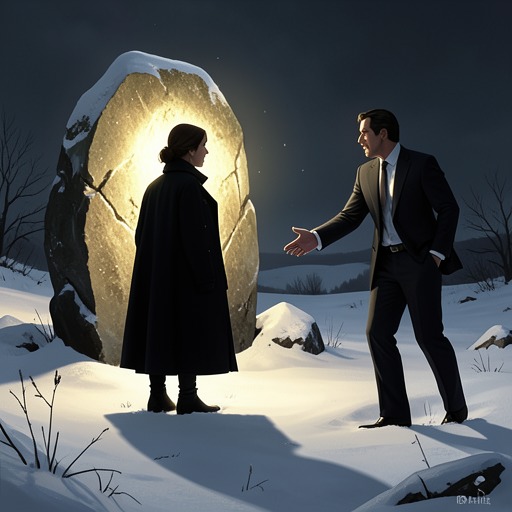
Willingdon family dream-vision legend
Under Your Spell: A Romance Boxed Set of Masked Balls, Haunted Gardens, Magic, and MoreThe Willingdon family dream-vision legend is a multigenerational tradition of extraordinarily vivid dreams in which a future Willingdon man recognizes the woman he will eventually regard as his destined wife. Its decisive significance lies in the way it converts private desire into inherited evidence: what might otherwise be dismissed as obsession or coincidence becomes, within the family, a recurring phenomenon that reaches across generations and helps explain why Julia saw Willingdon Manor before arriving there and why Paul believes their meeting was fated.
Definition and Family Pattern
The legend is presented as a hereditary dream tradition rather than a single isolated prophecy. Paul explains that his great-great-grandfather, Lord Willingdon, was engaged to a countess chosen by his family, with the marriage fully arranged. Three days before the wedding, however, he canceled it because he had dreamed of his future wife and knew that the woman in the dream was not the countess. His decision appeared irrational to those around him: his mother was furious, his sister was mortified, and others believed he had lost his senses.
The older generation supplied the legend with its first known repetition. Lord Willingdon Senior, Lord Willingdon’s father, had experienced a similarly vivid dream at approximately the same age. He told no one, persuaded himself that the vision was merely a trick of the subconscious, and proceeded with the marriage arranged by his parents. Three years afterward, he met the woman he had dreamed of. His silence did not disprove the experience; instead, it concealed the family pattern until his son acted on the same kind of vision.
The Legend’s Operation
The dream does not merely offer a general romantic intuition. It produces an unusually vivid image of a woman whom the dreamer feels certain is his future wife. The family therefore treats recognition as experiential and bodily rather than as a reasoned choice. Lord Willingdon rejects an advantageous arranged marriage because the dream has supplied a stronger form of knowledge, while Lord Willingdon Senior’s attempt to suppress that knowledge delays, but does not prevent, the eventual meeting.
Paul extends the pattern into the present. He tells Julia that he dreamed about her on the same day she saw the manor. He cannot explain how the phenomenon works, but he insists that it has continued for at least five generations, counting himself as the sixth. His certainty is strengthened by a physical impossibility attached to Julia’s vision: the view of the manor she saw in a painting cannot be reached by any path, because a hundred-foot rock face and then forest block the route. The unexplained correspondence between Paul’s dream and Julia’s vision makes the family legend more than a sentimental story; it becomes an active supernatural connection between dream, place, and encounter.
Julia, Paul, and Willingdon Manor
Julia’s arrival gives the legend its contemporary fulfillment. Paul reacts with private, almost disbelieving happiness after she enters his life, thinking that the legend is real. His response reveals that the inherited story has shaped his expectations long before he can prove them. The dream is not simply retrospective decoration after the meeting; it is the framework through which he understands the meeting as an answer to a long-standing family mystery.
Julia initially resists that interpretation. She points out that they have only just met and says that she came to the manor because of someone else. Paul acknowledges that another person’s arrival helped draw her there, but he interprets that circumstance as part of the same design: something had to bring Julia to the house so that the two of them could find each other. The legend consequently works through indirect causality. It does not require Julia to set out in search of Paul; the house, another relationship, and the unexplained vision together create the path by which the predicted recognition can occur.
The manor is central to this process because Julia’s vision of it precedes her physical arrival, while Paul’s dream of Julia occurs at the same time. The impossible view links them to a location that is both real and mysteriously inaccessible from the ordinary landscape. Willingdon Manor therefore functions not only as a family home but also as the spatial focus of the dream-vision tradition, the place where inherited expectation and present experience meet.
Secrecy, Recognition, and Inheritance
The legend is transmitted through both disclosure and concealment. Lord Willingdon Senior hides his dream because he fears it is only subconscious deception, whereas Paul tells Julia about his own dream with caution because he knows the claim may frighten her. The contrast shows that each generation must negotiate the same tension between rational explanation and supernatural certainty. The dream may be inherited as a family story, but accepting its authority remains a personal risk.
That tension echoes other forms of family inheritance in the wider narrative. Lavinia Lockett Sewall’s pregnancy fulfills her long-frustrated wish to become a mother, while the Abbot family inherits a lethal curse after acquiring a plantation from the Moriarty family through trickery. Griffin Durocher inherits public stigma from his grandmother Sophia Durocher’s notoriety, and Sophia’s return exposes the emotional costs of that inherited history. Against these darker transmissions of curse, scandal, and grief, the Willingdon dream tradition offers a more seductive inheritance: it promises that desire, identity, and partnership can also pass through generations.
Narrative Significance
The legend gives the story a supernatural explanation for fated recognition without removing uncertainty from the characters’ experience. Paul knows that the tradition works, but he does not know how; Julia witnesses a view that has no ordinary route; and neither fact can be reduced to a fully articulated mechanism. The narrative thus preserves a threshold between psychological interpretation and marvel. A dream could be dismissed as subconscious invention, yet the repeated family pattern and the impossible correspondence between Paul’s dream and Julia’s vision push the event toward the supernatural.
Its emotional power comes from the contrast between arranged expectation and unforeseen recognition. Earlier Willingdon men are expected to obey family plans, but the dream interrupts those plans with an image of a woman not yet known. Lord Willingdon’s canceled wedding dramatizes the cost of trusting the vision, while Lord Willingdon Senior’s delayed recognition shows the cost of refusing it. Paul’s encounter with Julia joins both precedents: he recognizes the inherited pattern, but Julia must decide whether that pattern has authority over her own life. In this way, the legend is simultaneously a prophecy, a family archive, and a pressure placed upon the present.
The tradition also explains why Paul sees Julia as more than a chance visitor. His happiness on realizing that the legend is real, his knowledge of the manor’s inaccessible geography, and his insistence that the pattern reaches six generations all transform their meeting into an event charged with ancestry. The dream does not merely predict a romance; it makes the romance legible as the latest occurrence in a chain of visions, refusals, delayed encounters, and eventual recognition.